
By Laurenz Van de Sande — CryptoNewsHub
France / New York — November 1, 2025 | 09:20pm CET
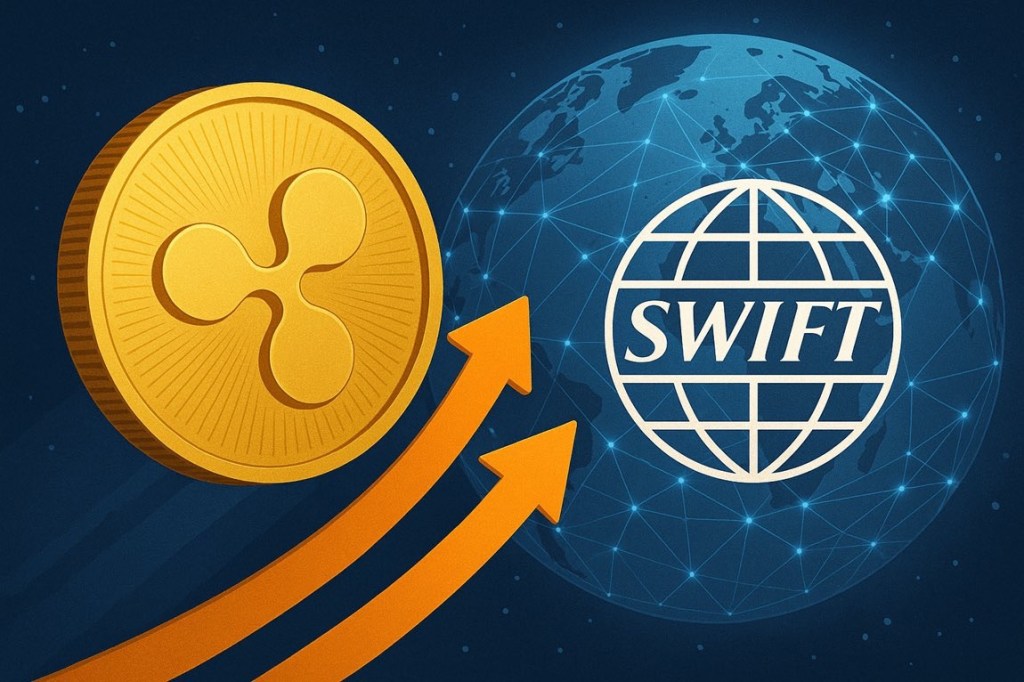
For more than a decade, blockchain innovators like Ripple and Stellar have promised to revolutionize global money transfers — to end the reign of SWIFT, the century-old network that handles most of the world’s cross-border banking messages.
But as the dust settles on years of disruption talk, it appears the old guard isn’t going anywhere. In fact, SWIFT is quietly building its own blockchain, aiming to integrate digital assets and tokenized money into the global financial system — on its own terms.
The Great Blockchain Promise
Back in the 2010s, fintech pioneers cast blockchain as the future of global finance — faster, cheaper, and borderless. Ripple Labs and Stellar, two of the most prominent blockchain networks focused on payments, positioned themselves as direct competitors to SWIFT, which they argued was outdated, slow, and costly.
Ripple board member Asheesh Birla captured that vision in 2020:
“Blockchain technology allows businesses and financial institutions to transact directly, eliminating the need for a middleman like SWIFT.”
Ripple CEO Brad Garlinghouse went even further in 2018:
“What we’re doing and executing on a day-by-day basis is, in fact, taking over SWIFT.”
Stellar echoed that confidence, dedicating entire sections of its platform to highlighting SWIFT’s inefficiencies — predicting that blockchain rails would make the traditional system obsolete.
SWIFT’s Quiet Evolution
But SWIFT, the Society for Worldwide Interbank Financial Telecommunication, didn’t fade away. Instead, it began to adapt.
In recent years, the organization has modernized its messaging network, integrated faster domestic payment systems like FedNow, and worked with banks to make settlement times shorter. Yet, even with upgrades, traditional SWIFT transfers can still take up to five business days.
Behind the scenes, though, something bigger has been happening. SWIFT’s innovation labs have been developing blockchain-based solutions — not to replace banks, but to connect them more efficiently in a world increasingly defined by digital currencies and tokenized assets.
Building a Blockchain for Banks
In a partnership with Consensys, the Ethereum development firm, SWIFT recently announced a new prototype blockchain ledger that will enable banks to exchange tokenized value across platforms.
The goal? To build an open ledger that serves as a bridge between financial institutions, central banks, and blockchain ecosystems — effectively ensuring interoperability in a fragmented financial world.
“The types of tokens that will be exchanged on the ledger is the territory of commercial and central banks,”
SWIFT said in a statement. “Our role is to provide the means of interoperability.”

That approach could make SWIFT indispensable once again — not as a payment processor, but as the universal standard for cross-chain communication, linking central bank digital currencies (CBDCs), stablecoins, and other tokenized assets.
From Competition to Collaboration
Since at least 2022, SWIFT has been studying how CBDCs and tokenized assets could work alongside traditional banking infrastructure. Its latest project brings that vision closer to reality.
Rather than being displaced, SWIFT has positioned itself as the intermediary layer between new blockchain networks and the traditional financial world — the same role it played for decades in interbank messaging.
This evolution underscores a paradox: while blockchain was built to disintermediate finance, SWIFT’s new strategy reimagines its role as a connector of blockchains — not a victim of them.
“Blockchain platforms like Ripple and Stellar helped create the very fragmentation SWIFT now aims to solve,”
said one industry analyst. “Ironically, they made SWIFT more relevant in the next phase of financial innovation.”
Fragmentation and the Future of Finance

Today’s financial landscape is more fragmented than ever. There are hundreds of private and public blockchains, dozens of emerging CBDC pilots, and countless tokenized asset platforms. None of them speak a universal language — yet.
SWIFT’s blockchain strategy aims to fill that gap, offering a common interoperability layer that could connect every institution and blockchain under a single framework.
While this may limit the disruptive ambitions of decentralized payment networks, it could bring regulatory clarity, scalability, and trust — key ingredients for mainstream adoption.
As one fintech executive put it:
“If the global financial system is going to tokenize, it needs a common language. SWIFT already speaks that language — and now it’s learning blockchain.”
The End of the “SWIFT Killer”?
Ripple and Stellar may still play important roles in global payments, particularly in regions underserved by traditional banking. However, the idea of “replacing SWIFT” seems increasingly unrealistic.
Instead, the focus is shifting toward integration rather than replacement — with SWIFT emerging as the bridge between legacy finance and blockchain-based systems.
In a sense, SWIFT’s reinvention marks the beginning of a new era: one where old and new infrastructures converge, and where the line between traditional banking and blockchain finance grows thinner each year.
#SWIFT #Blockchain #Ripple #Stellar #CBDC #Tokenization #Consensys #Fintech #Payments #CryptoNewsHub
© 2025 CryptoNewsHub. All rights reserved.
 CryptoNewsHub
Leave a comment