
By Laurenz VDS
New York – October 29, 2025
“This is not the end of the storm. It’s a brief clearing in the clouds.”
— Chinese political analyst, Beijing
A Precarious Pause Before the Summit
After years of tariffs, sanctions, and rhetorical sparring, the United States and China appear to be inching toward a tentative truce in their long-running economic conflict. The breakthrough—still fragile and provisional—comes just days before Presidents Donald Trump and Xi Jinping are due to meet face-to-face on the sidelines of the APEC Summit in South Korea.
Following two days of closed-door talks in Kuala Lumpur, U.S. Treasury Secretary Scott Bessent and Chinese Vice Premier He Lifeng announced what both sides called a “framework agreement.” The deal postpones Beijing’s planned export restrictions on rare earth minerals and forestalls a new wave of U.S. tariffs that had been set to take effect in November.
Beijing also agreed to resume purchases of American soybeans, a symbolic gesture that could carry political weight for Trump as he heads into the high-profile summit.
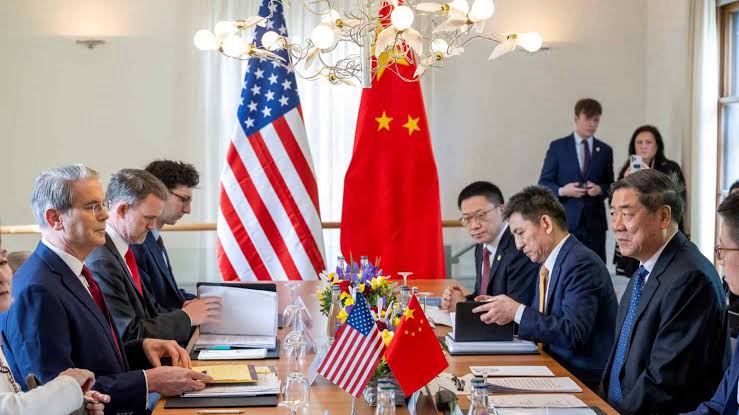
“We’ve reached a very substantial framework that will avoid escalation,” Bessent told NBC. “It opens the door for broader discussions with the Chinese, including cooperation on the fentanyl crisis and even on Ukraine and Russia.”
Leverage and Calculation
Bessent credited the administration’s earlier threat of a 100% tariff on Chinese goods with providing “a great deal of negotiating leverage.” But his tone suggested that the era of brinkmanship may be giving way to something more pragmatic.
Chinese negotiators described the exchanges as “candid,” diplomatic shorthand for talks that were serious but not confrontational. The framing reflects a subtle recalibration by both sides—each aware of the political and economic costs of renewed escalation.
For Washington, the deal offers breathing room amid global inflation pressures and volatile markets. For Beijing, it buys time as it manages slowing growth and an uncertain export outlook.
The TikTok Deal: Tech Meets Diplomacy
In parallel, Bessent confirmed that the two countries had finalized an agreement over the fate of TikTok, the Chinese-owned social media platform that has long been at the center of U.S. data-security concerns.
Speaking to CBS, Bessent said the terms were settled during earlier discussions in Madrid and would be “consummated” by Trump and Xi during their meeting in Korea.
Under the arrangement, TikTok’s U.S. operations will be transferred to a consortium of American investors—reportedly including Oracle, Silver Lake Management, and MGX—while parent company ByteDance will retain a minority stake and license the algorithm to the U.S.-controlled entity.
“The TikTok deal encapsulates the broader U.S.–China dilemma,” says one Washington-based analyst. “It’s not just about trade—it’s about trust, technology, and control.”
Rare Earths and the Limits of Leverage
For years, rare earth minerals have been portrayed as Beijing’s strategic weapon—a resource it could restrict to punish Western rivals. But as global supply chains shift, that leverage has weakened.
Chinese analysts now acknowledge that the world is diversifying its supply sources, from Australia to the United States. “Export controls would hurt Chinese producers as much as foreign buyers,” one Beijing scholar noted. The decision to delay restrictions for a year thus reflects pragmatism more than concession.
Still, the symbolism remains powerful. Rare earths once epitomized China’s dominance in the global technology ecosystem; now they illustrate how interdependence constrains both powers.
A Pause, Not Peace
Both governments are portraying the Kuala Lumpur framework as progress. Trump declared that “both countries want to make a deal,” while Beijing’s statements emphasized “mutual respect” and “win–win cooperation.”
Yet beneath the diplomatic pleasantries, deep strategic mistrust persists. The rivalry extends beyond trade—into technology, geopolitics, and ideology. The new framework offers a pause, not peace, and its durability will depend on the leaders’ ability to turn tactical compromise into sustained dialogue.
As one veteran Chinese commentator summarized, “This is not reconciliation—it’s recalibration.”
For now, that may be the most either side can afford.
At a Glance: Key Points from the U.S.–China Framework
Rare Earths: China to delay export controls by one year. Tariffs: No new U.S. tariffs on Chinese imports scheduled for November. Agriculture: Beijing to resume purchases of U.S. soybeans. TikTok: U.S. investors to acquire controlling stake in American operations. Next Steps: Trump–Xi meeting at APEC Summit, South Korea, October 30.
Reporting by Laurenz VDS. Additional reporting from New York and Kuala Lumpur.
© 2025 CryptoNewsHub.
 CryptoNewsHub
Leave a comment